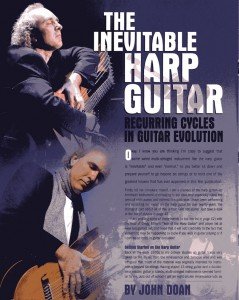
 “The Inevitable Harp Guitar- Recurring Cycles in Guitar Evolution” was published in Fingerstyle Guitar Magazine No.66, and is used here with permission. For more information on harp guitar history go to harpguitars.net.
Back in the early 1970’s in my college studies on guitar I was very taken by the music from the renaissance and baroque eras and was intrigued that much of the material was originally intended for instruments beyond six strings. Having played twelve-string guitar and a double neck electric guitar in bands multi-stringed instruments seemed familiar to me. Just out of school I got an eight-course renaissance lute as well as a fourteen-course theorbo to play original lute music and included them in my guitar concerts.
Over time I began to recognize all sorts of multi-stringed instruments in some music shops, museums, and in books on instruments and was curious that hardly anyone played them or even seemed to know much about them. There were various lute-guitars (a.k.a. “lutars”) from late 19th/early 20th century Germany (those who think poorly of them call them “gututes”), Basse-guitares or Schrammel guitars from Europe (especially from Sweden, France, Germany, Italy and Eastern Europe), and harp guitars from early 20th century America.
These guitars all had an extended bass range with up to twelve additional strings. I even found a harp guitar made by Chris Knutsen in Port Townsend, Washington from the late 1890’s with seven additional super-trebles attached to the right of the ordinary six strings of the guitar. In time I acquired a Gibson harp guitar (literally hundreds were made in Gibson’s first twenty years), a Dyer harp guitar (made by the Larson brothers and still popular today especially since adopted by such great players like Michael Hedges and Stephen Bennett, among others), and various lesser known makes. I finally commissioned a twenty-string harp guitar (perhaps the first modern constructed harp guitar design in our times) from John Sullivan and Jeffrey Elliott of Portland, Oregon in 1985 and haven’t looked back since. *(note: William Eaton was building amazing multi-stringed creations of his own even before this).